Last updated:
Alcovy Septic handles commercial septic pumping in Gwinnett County, along with Rockdale and western Walton, for the buildings that never got a sewer line: churches, daycares, offices, machine shops, farms, small strip centers and event venues. Roughly 27 to 30 percent of Gwinnett is still on septic, one of the heaviest concentrations in the country according to Gwinnett County, and plenty of that is commercial property on large lots.
A commercial system is not a house system with a bigger lid. It is usually more tanks, more pumps and more things that fail on the day you have the most people in the building.
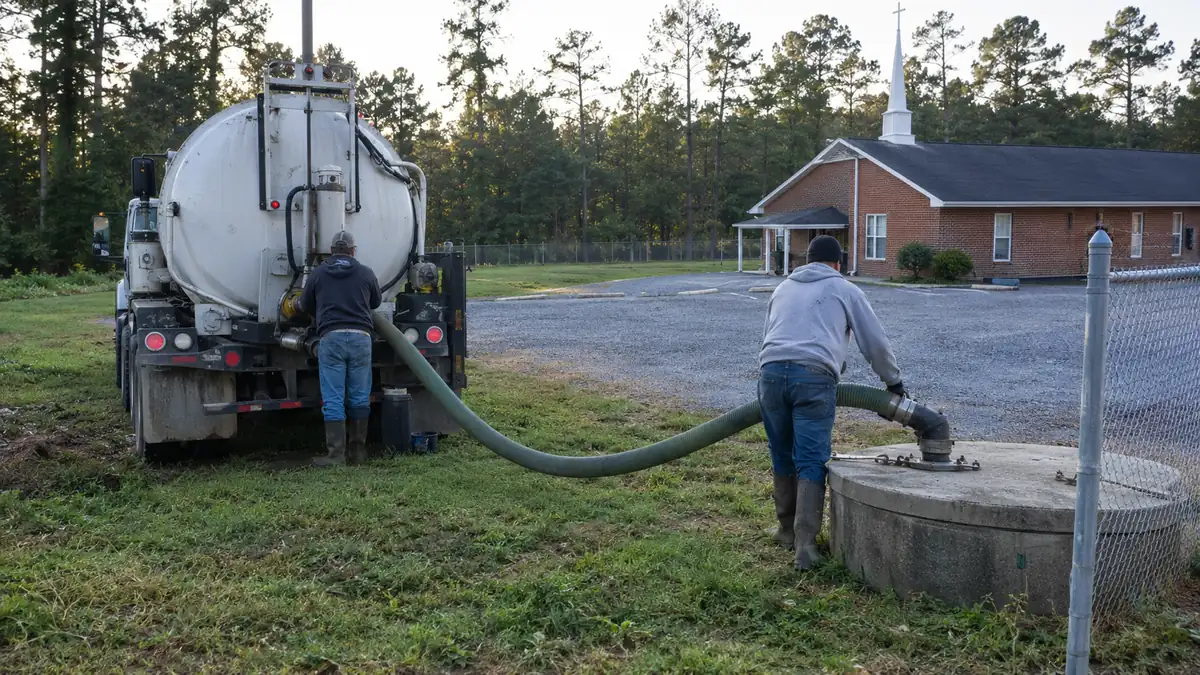
What happens on a commercial visit
The crew starts with what is actually in the ground, not what the last contractor assumed. That means locating every lid on the property: the primary tank, any second tank in series, the pump or dose chamber, and the grease interceptor if the building has a kitchen. If lids are buried, risers usually pay for themselves by the second visit, because digging time is charged on every trip.
Every compartment gets pumped. Georgia requires residential tanks to be two-compartment with the first holding at least two-thirds of the volume (Rule 511-3-1-.05), and commercial tanks are commonly two tanks in series on top of that. Pumping the first one and calling it done leaves half the solids in place.
With the tank empty, the crew checks the inlet and outlet baffles, pulls and cleans the outlet effluent filter, and records sludge and scum depths. Those two numbers are what set your next interval.
Your interval comes from flow, not bedrooms
Residential advice is written in bedrooms. That measure is useless for a daycare or a fellowship hall, so commercial systems are designed and scheduled on estimated daily flow for the use type. Georgia’s design criteria put offices and factories at 25 gallons per person per day, restaurants at 50 gallons per seat per day, hotels at 75 gallons per guest and residences at 150 gallons per bedroom (Georgia DPH).
Run the arithmetic and the picture changes fast. A 30-person office moves about 750 gallons a day. A 60-seat cafe is designed around 3,000. The same state document notes that restaurant wastewater is two to three times stronger than residential wastewater in oxygen demand and suspended solids, which is why food service clogs soil absorption fields faster even when the volume looks modest.
A church is the opposite problem: near-zero flow Monday through Saturday, then a spike. Tanks sized for the spike sit under-loaded all week and still fill with solids, so the interval is set by measured sludge depth rather than a calendar habit. Our pumping frequency guide covers how that measurement works, and the cost estimator gives you a residential baseline to start from.
What a commercial system has that a house doesn’t
More tank volume, often split. Two or three tanks in series, sometimes 2,000 to 5,000 gallons each. Each has its own access and its own sludge profile.
A pump or dose chamber. Flat or clay sites usually dose the field with a pump on floats rather than relying on gravity. That chamber needs pumping too, and a failed float looks exactly like a full tank from inside the building.
A grease interceptor. Any building with a commercial kitchen has one ahead of the tank. It is a separate vessel on a separate schedule — see grease trap pumping for what that service involves and how often it is expected.
An aerobic treatment unit. On tight clay lots where a conventional field would not perc, the permit often required an ATU. Those have blowers, media and a maintenance contract behind them; aerobic system service is its own visit.
Long runs of pipe. Commercial buildings put more distance between fixture and tank, which is where grease, sludge and pine and water oak roots collect. When the tank is empty and the building still drains slowly, the line is the problem and septic line jetting is the tool.
Records the inspector actually asks for
A health inspector reviewing a food service or childcare property will ask when the system was last serviced and want a document, not a memory. Every visit should leave you with the date, the company, the gallons removed, the tank size, what was found and where the septage went.
Keep them together in one file on site. The same records support a Gwinnett stormwater fee credit — the county allows a 10 percent credit for five years on a dated receipt from a licensed hauler — and they are the first thing a buyer’s inspection will request if you ever sell the building.
What it costs
Published local pricing is written around houses. Homeyou’s June 2026 data puts a standard Lawrenceville-area pump-out at $280 to $520, with a full observed range of $196 to $789. Commercial work scales from there on volume, tank count and access, and after-hours work typically carries a 50 to 100 percent premium.
One cost driver is not obvious from the outside: disposal. Gwinnett charges $130 per 1,000-gallon ticket for septage at its receiving sites in the 2026 DWR fee schedule, so a 5,000-gallon property carries real disposal cost before a truck moves. You hear the range before anything is scheduled. Our Lawrenceville pumping cost guide breaks down the residential baseline.
Who is allowed to pump it
In Georgia, septic tanks must be pumped by a certified pumper working for a company that holds a county septage removal permit, per the Georgia Department of Public Health. Certification requires passing an exam with a score of at least 70. Ask for both — the individual certification and the company’s county permit — before anyone opens a lid. The vetting guide explains what to ask for.
The US-29 corridor
Commercial septic clusters where older commercial zoning outran the sewer. The Lilburn stretch of US-29 is the clearest example in our area: 1960s to 1980s buildings, some of the oldest tank stock in Gwinnett, and enough businesses searching for commercial septic tank services in Lilburn GA to show up in the keyword data. The same pattern runs through Snellville along US-78 and out into Loganville, where Walton County has no sewer planned at all. If your building is in one of those pockets, get in touch and we will size an interval to the flow.
What's included
- Site walk to confirm tank count, sizes and access
- All compartments and all tanks pumped, not just the first
- Pump chamber and dose tank checked and pumped where fitted
- Inlet and outlet baffles inspected
- Effluent filter pulled, cleaned and reseated
- Grease interceptor serviced where one is present
- Sludge and scum depths recorded for the next interval
- Dated record with gallons, tank size, findings and disposal site
Sources
- Georgia DPH — Design criteria for peak sewage flow
- Georgia DPH — How to become a certified installer or pumper
- Georgia Rule 511-3-1-.05 — Septic tank requirements
- Gwinnett County — Septic tanks
- Gwinnett County DWR — Rates and fee schedule 2026
- Homeyou — Septic pumping costs in Lawrenceville, GA (June 2026)