Skip to content

Septic pumping across Gwinnett County · Office Mon–Fri 7am–6pm · Emergency line 24/7

Alcovy Septic SEPTIC TANK PUMPING

Septic Riser Installation and Tank Locating in Lawrenceville, GA

Most Gwinnett tanks sit two to three feet down under red clay, and nobody in the house knows where. We find the lid using county records, the plat and a probe, then set a sealed riser so the next pump-out, inspection or filter cleaning starts at ground level.

Price range given before dispatch · Answered 24/7

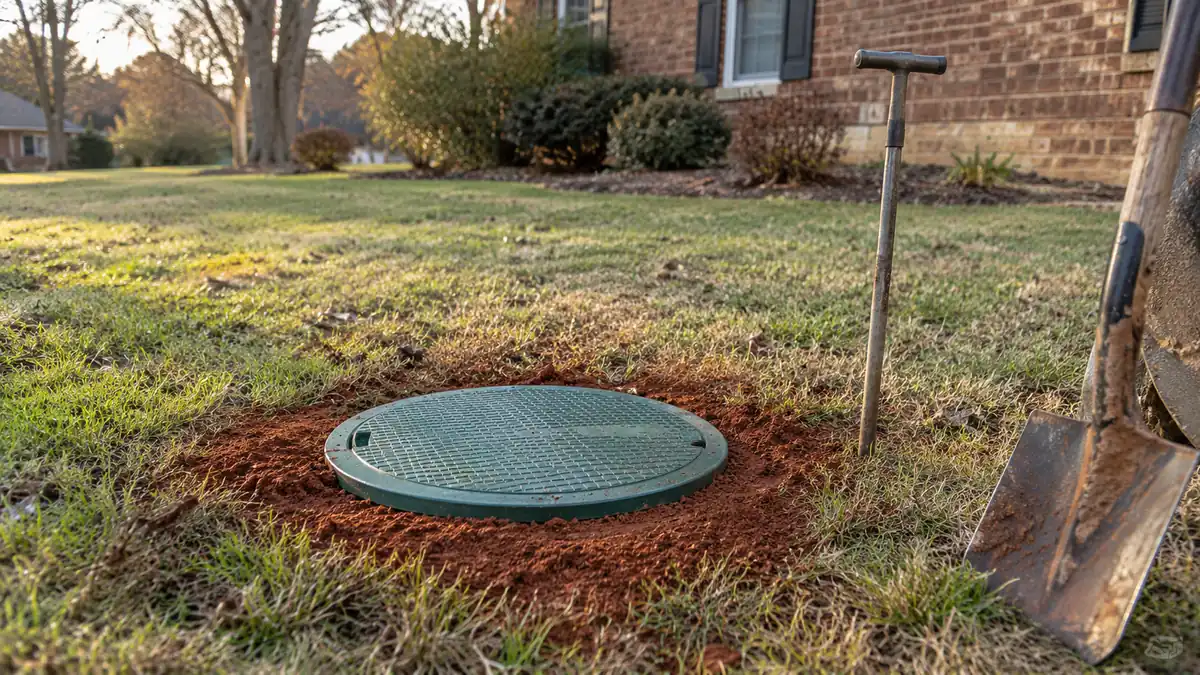
Green septic riser lid set flush at ground level in a Lawrenceville lawn after installation

Signs you need this

When to call for locating & risers

Nobody knows where the tank is

You bought the house and the lid was never pointed out. Until it is found, every service call starts with a probe and a shovel, and you pay for that time.

You paid a dig fee last time

A dig charge on the last pumping invoice means the lid is buried. Two more pump-outs and you will have spent more on digging than a riser would have cost.

The lid is cracked or broken

Old concrete lids crack and thin steel lids rust through. A failing lid is a child and pet hazard, and it lets surface water run straight into the tank.

A filter that needs regular access

Georgia requires an outlet filter on the tank. If it has to be cleaned once or twice a year, digging to reach it every time makes no sense.

Last updated:

Alcovy Septic handles septic riser installation in Lawrenceville, GA along with the part that comes first for most callers: actually finding the tank. In a county where roughly 27 to 30 percent of households are on septic, a very large number of those lids have not been seen since the house was built, and every service visit that starts with a shovel costs you money that a one-time riser would have eliminated.

Finding a buried lid

There are three ways to find a tank, and we work through them in order of cost to you.

County records. Gwinnett’s septic records go back to 1959 and have been free online since 2011 through the county’s GIS Data Browser, using the Septic Tank Parcels layer. Pull the parcel and you often get an approximate tank position, the install date and sometimes the tank size. That is usually enough to point a probe at the right ten feet of yard instead of the whole back lot. The step-by-step lookup is in our Gwinnett County septic records guide.

The plat and the house itself. If the county layer is thin, the plat filed with the property or the original permit drawing often shows the field lines, and the field tells you where the tank is because the tank always sits between the house and the field. Inside, find where the main sewer line leaves the building. The tank is almost always on that side, in a straight line out.

The probe. A thin steel rod on a grid, working outward from the house exit. Georgia’s rules say tanks should be installed at least ten feet from foundations, drives, hardscape and pools, and to allow ready access for maintenance, so the search starts at about ten feet and works out. Around Lawrenceville the lids typically sit one to three feet below grade. On older homes built before risers were common, twelve to thirty inches of red clay over the lid is the norm.

Probing is done carefully. A rod driven hard in the wrong place can crack a thin concrete lid or punch a hole in a field line, so the crew probes down to contact and then confirms by hand-digging the last few inches. Both access points get located, not just the first one found, because Georgia requires two compartments and a crew that only opens the first side leaves half the tank unserviced.

What a riser is and why the state effectively wants one

A riser is a short cylinder, usually polyethylene or sometimes concrete, that sits on the tank’s access opening and carries it up to ground level, finished with a secured lid you can lift by hand.

Georgia’s on-site sewage rule is specific on two points that matter here. Rule 511-3-1-.05 states that all openings, risers and manholes must be constructed so as to prevent the entrance of surface water, and that tanks must be installed so as to provide ready access for necessary maintenance. A lid under two feet of clay does not provide ready access, and a riser installed without a proper seal fails the first test. Both halves matter: a riser that lets stormwater run into the tank is worse than no riser at all, because it floods the tank and pushes hydraulic load onto the drain field every time it rains.

The same rule requires an approved filter on the outlet end of the tank. That filter needs periodic cleaning, and effluent filter cleaning is a ten-minute job when the lid is at grade and an excavation when it is not.

The payback math

Published Georgia figures make this easy to work out. Septic & Well Pro reports that buried lids without risers add $50 to $150 for digging to a pumping job, and that a $200 to $400 riser installation pays for itself within two pump-outs by eliminating that charge. Red clay in the Piedmont makes the digging slower than it would be elsewhere, which pushes the dig charge toward the top of its band and shortens the payback further.

Now add the visits people forget. Over a ten-year stretch a typical Lawrenceville household will see two or three pump-outs, at least one or two filter cleanings, and quite possibly a real-estate inspection. That is four to six openings of the tank. At $50 to $150 each, you are looking at $200 to $900 in digging charges against a one-time $200 to $400 riser.

Over 10 yearsNo riserWith riser
Pump-outs (2–3)$100–$450 in digging$0
Filter cleanings (1–2)$50–$300 in digging$0
Inspection for a sale$50–$150 in digging$0
Riser install$0$200–$400
Total access cost$200–$900$200–$400

The full breakdown, including why companies charge for digging in the first place, is in the septic riser cost guide. If you want to see how the dig charge lands on top of a standard pump-out price, the Lawrenceville pumping cost guide and the cost estimator both show it as a line item.

When a riser is not the right answer

Not every tank should get one.

The tank opening is damaged. If the concrete collar around the access opening is crumbling, a riser has nothing sound to seat on. That becomes a septic tank repair first.

The lid itself has failed. Cracked concrete and rusted-through steel lids are a genuine hazard, and they get replaced rather than covered.

The tank is at the end of its life. If the inspection finds a tank with a failed baffle, a corroded interior and a field already surfacing, spending money on access is the wrong order of operations. Get a septic tank inspection first and decide from the findings.

The tank is unusually deep. A tank set four or five feet down needs a taller riser stack, which costs more and needs to be properly supported. It is still usually worth doing, but the price moves.

After the install

The riser goes in, the grade around it is restored, and the location is written on your paperwork so the next person who services the system does not start over. Mark it on a sketch of the property and keep it with the house records along with your pumping receipts, which also earn Gwinnett’s stormwater fee credit.

From there, maintenance gets simpler. How often to pump a septic tank in Georgia sets the interval, and once you can open the lid in a minute, checking sludge depth stops being a project. Call or use contact with your address, and we will check the county records before quoting the locate.

What's included

  • County septic record and plat search before arrival
  • Probe search on a grid from the house sewer exit
  • Both access points located, not just the first
  • Depth to lid measured and recorded
  • Existing lid condition checked and reported
  • Riser and sealed lid set on the tank opening
  • Backfill, compaction and grade restored around the riser
  • Tank location noted on your paperwork for next time

Upfront pricing

What locating & risers costs

Published ranges for the Lawrenceville area, so you know what's fair before you call anyone.

What changes the price

  • Tank size and how full it is
  • How deep the lid is buried
  • After-hours, weekend or holiday timing
  • Access for the truck hose (typically 100–150 ft)
Estimate your price in 30 seconds
  • Tank locating with probe and records

    Same band as a dig charge; waived on some jobs when combined with pumping

    $50–$150

  • Riser and sealed lid installed

    Per riser, set on a sound tank opening at typical depth

    $200–$400

  • Digging to a buried lid

    What you pay again at every future pump-out without a riser

    $50–$150

Ranges are typical market prices drawn from the sources listed on this page, not a quote. Your price is confirmed before work starts.

Compare

What your options actually get you

Three ways homeowners handle a buried lid. Dollar figures are published market ranges, not quotes.
Factor Dig it up every timeLeave the lid exposedInstall a sealed riser
Cost per service visit $50–$150 in digging, every visit$0$0 after the one-time install
Time added to each visit 30–90 minutes in red clayNoneNone
Surface water entering the tank Risk each time the lid is reseatedHigh, an exposed opening takes runoffSealed to keep surface water out
Safety Open hole while the crew worksTrip hazard and a mower hazardLid at grade, secured and visible
Filter and inspection access Only when you pay to digEasy but unprotectedOpen it in under a minute
One-time cost $0 up front$0 up front$200–$400 per riser

Three ways homeowners handle a buried lid. Dollar figures are published market ranges, not quotes.

Guides

Read before you book

The process

How locating & risers works, step by step

  1. Records first

    We check the Gwinnett GIS septic layer and any plat you have before the truck rolls. County septic records go back to 1959, and a hit on the map usually saves an hour of probing in the yard.

  2. Probe and confirm

    The crew works out from where the sewer line leaves the house, probing on a grid. Tanks normally sit at least ten feet from the foundation with the lids one to three feet down.

  3. Expose and assess

    The opening is uncovered by hand near the lid so nothing gets cracked. We check the existing lid, the tank collar and whether the opening is sound enough to carry a riser.

  4. Set and seal the riser

    The riser is seated on the tank opening, sealed so surface water cannot enter, fitted with a secured lid at grade, then backfilled and the grade restored around it.

Stop paying to find your own septic tank.

Alcovy Septic will locate the lid, tell you what it would take to bring it to grade, and give you the price range before any digging starts.

FAQ

Locating & Risers questions

Where is my septic tank usually buried?

Follow the sewer line out of the house and look ten to twenty feet from the foundation on that side. Georgia rules say tanks should sit at least ten feet from foundations, drives and hardscape, and lids in Gwinnett typically sit one to three feet below grade. Older homes with no riser are commonly twelve to thirty inches down.

Can I look my septic tank up with Gwinnett County?

Often, yes. Gwinnett has septic records going back to 1959 and has published them free online since 2011 through its GIS Data Browser using the Septic Tank Parcels layer. The record gives the parcel and frequently an approximate tank location. It will not always show the exact lid, but it narrows the search a great deal.

What exactly is a septic riser?

A riser is a short cylinder, usually polyethylene or concrete, that sits on the tank's access opening and brings it up to ground level with a secured lid on top. Georgia's rules require that openings, risers and manholes be built so surface water cannot get in, and that tanks be installed to allow ready access for maintenance.

Is a riser worth the money?

Do the arithmetic. A riser runs about $200 to $400, and digging to a buried lid runs about $50 to $150 every time someone services the tank. At a three to five year pumping interval plus the occasional filter cleaning or inspection, the riser typically pays for itself in two to three visits, and it pays sooner in hard clay.

Will a riser look bad in my yard?

It is a flat lid roughly two feet across sitting level with the grass. Most are green or black. You can mow over it, and it is far less visible than the patch of bare dirt left behind each time someone digs the tank open. Do not bury it again, and do not park or drive over it.

Do you give a price before you start?

Yes. You hear a price range on the phone, and the crew confirms the final price once the lid is uncovered and they can see the tank. If anything changes the price, such as a deeper dig or a lid under concrete, they stop and ask before continuing.

Keep going

Related services

  • Septic Tank Inspection

    Sludge and scum measured, baffles and filter checked, drain field walked. Written findings for buyers, sellers and lenders.

    Book an inspection
  • Effluent Filter Cleaning

    Georgia requires an outlet filter on newer tanks. A clogged one backs up the house long before the tank is full.

    Clean my filter
  • Septic Tank Repair

    Broken baffles, cracked lids, clogged outlet filters and failed inlet pipes repaired and documented.

    Fix my tank

Next step

Find it once, mark it, and never dig for it again.

Prefer not to call? Send two quick details and a dispatcher will call back within 15 minutes.

Get a free septic pumping quote

Two quick steps. A local dispatcher will call back within 15 minutes.

Step 1 of 2
Step 2 of 2

Faster: call (470) 299-0510. We never share your details.

Call (470) 299-0510 · 24/7