Last updated:
Alcovy Septic books septic tank inspection in Lawrenceville, GA for buyers under contract, sellers getting ahead of the offer, lenders asking questions and owners who simply inherited a system with no paperwork. The visit is a measured evaluation of the whole system, not a glance at the lid, and it ends with a dated report you can hand to an agent, an underwriter or the next contractor.
What a full inspection includes
The EPA’s homebuyer guidance sets the baseline, and it is a useful checklist to hold any inspector to. EPA says an inspection should cover pumping and maintenance records, the age of the system, sludge levels and scum thickness in the tank, signs of leakage such as a low water level, signs of backup such as staining above the outlet pipe, the condition of the tank and its inlet and outlet pipes, the drain field for standing water or other signs of failure, and the distribution box to confirm the drain lines are receiving equal flow.
In practice that runs in a set order.
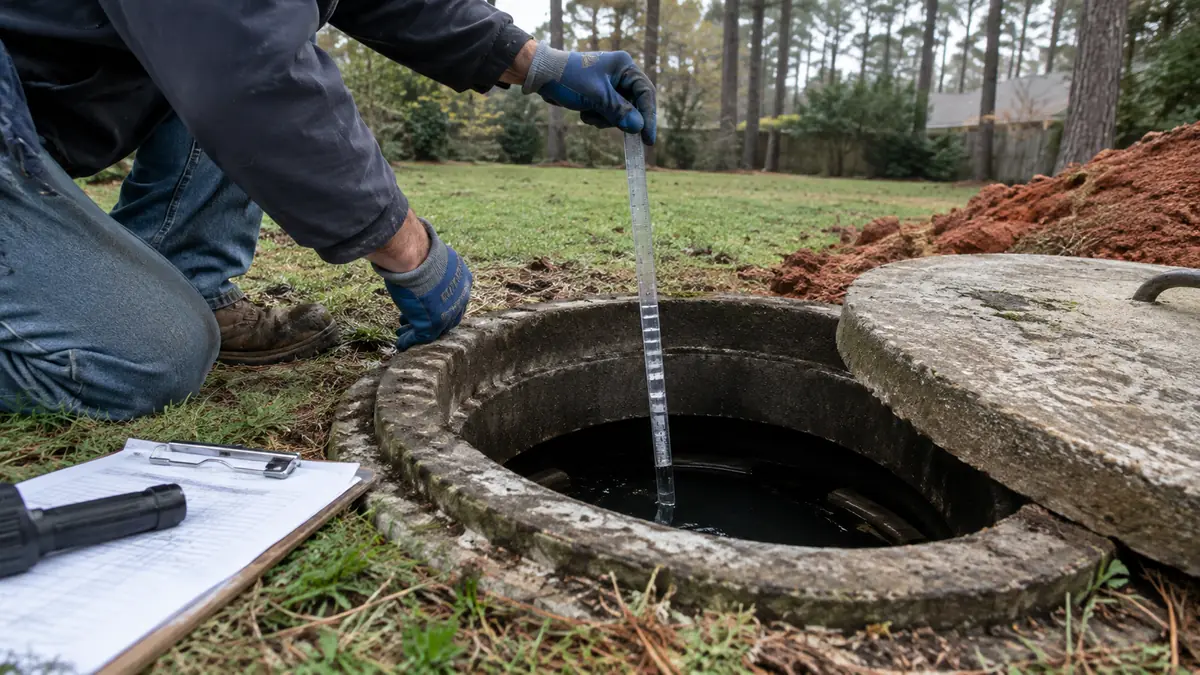
Sludge and scum get measured first. A probe goes down through both compartments before anything is pumped. The numbers that matter are how thick the scum mat is at the top, how deep the sludge blanket is at the bottom, and how much clear zone is left between the sludge and the bottom of the outlet baffle. Guessing at this from the surface is not an inspection.
The liquid level is checked against the outlet. A level well below the outlet invert suggests the tank is leaking. A level above it suggests the outlet, the filter or the field is restricting flow. Both findings change what happens next, and neither is visible without a tape.
Both baffles get eyes on them with the tank empty. The inlet baffle keeps incoming flow from stirring the sludge blanket. The outlet baffle holds the scum mat back so it never reaches the field. Concrete baffles in tanks from the 1980s and 1990s crack and drop, and a dropped outlet baffle is the single most common repairable defect we write up. See septic tank repair for what those fixes involve.
The outlet effluent filter comes out. Georgia rules require an approved filter on the outlet end of the tank. It is pulled, hosed off and reseated, and its condition gets noted. A filter packed solid explains a slow-draining house far more often than a full tank does.
The distribution box gets opened where one exists. The D-box splits effluent between the trenches. When it has settled, cracked or silted in, one lateral takes everything and fails while the rest sit dry. That is a cheap fix caught early and an expensive one caught late, which is the whole argument for inspecting before drain field repair becomes drain field replacement.
The field gets walked and probed. The crew looks for ponding, surfacing effluent, odor, and grass that is greener or lusher over one trench line. A dye or flow test can be added when the field is genuinely in question.
Buyer, seller and lender are three different jobs
Buyers want to know what they are taking on. A system with a dropped baffle and a clogged filter is a few hundred dollars. A field that has been surfacing for two years in red clay is five figures. The gap between those two outcomes is why the inspection belongs inside your due-diligence window, not after it. Our guide on septic inspection when buying a house in Georgia covers the timing and what to ask for.
Sellers get ahead of it. Pumping and documenting the system before the listing removes a negotiating lever and stops a surprise finding from re-opening price talks two days before closing. That is the case laid out in should you pump the septic before selling, and the seller-side package is septic pumping before a home sale.
Lenders are the wild card. Georgia has no statewide point-of-sale septic inspection requirement, so state law will not force anyone’s hand. FHA is where it usually bites: HUD’s Handbook 4000.1 requires the on-site sewage system to be functioning properly and to meet local health department requirements, and the appraiser is expected to examine the property and report observable deficiencies. Surfacing effluent, a soggy patch or an odor in the yard on appraisal day turns into a loan condition, and then everyone is scheduling an inspection under time pressure.
Why the tank gets pumped for a proper inspection
You cannot see through effluent. With the tank full, the baffles, the tank walls, the inlet connection and the outlet invert are all under water. Pumping is what converts a guess into an observation, which is why the Georgia real-estate evaluation price band sits well above a basic visual check.
There is a second reason. Measuring sludge and scum has to happen before the pump-out, because that measurement is the record of how the system has actually been used. An inspector who pumps first and measures after has thrown away the most useful number on the report.
If nobody knows where the tank is, start with records. Gwinnett’s septic records go back to 1959 and the county publishes a septic tank layer in its GIS Data Browser; our walkthrough is in Gwinnett County septic records. If the lids are buried, septic tank locating and risers is the fix that stops you paying to dig at every future visit. Unsure of the tank volume? How big is my septic tank explains how Georgia’s bedroom-count rule sets it.
What a septic inspection costs
HomeGuide puts a septic tank inspection at $150 to $450 for a maintenance-grade check. For Georgia specifically, Septic & Well Pro reports $400 to $600 for a real-estate transaction evaluation, $600 to $1,200 for a full diagnostic with camera work, and $100 to $250 for dye testing, which is not usually included as standard. Digging to a buried lid adds roughly $50 to $150.
Metro Atlanta sits at the upper end of every one of those bands. The full breakdown is in our Georgia septic inspection cost guide, and if you want a quick read on urgency before booking anything, the septic system assessment takes about a minute. You will hear a price range on the phone before anything is scheduled, and the quote is confirmed before work starts.
Paperwork, permits and what happens after
The report lists the date, the tank size, gallons removed, sludge and scum depths, component condition and recommended follow-up. That is the format home inspectors, agents, underwriters and the county all accept, and it is also the receipt you need for Gwinnett’s stormwater fee credit.
If the inspection finds something that needs correcting, the next question is whether it needs a permit. Repairs to the tank or field go through GNR Environmental Health, and since February 2022 a Level 3 soil report is required for all septic permits in the district, including repairs. Septic repair permits in Gwinnett walks through that process. If you want the inspection scheduled around a closing date, send the date through contact and we will work backwards from it.
What's included
- Tank located and both lids uncovered
- Sludge depth and scum thickness measured
- Liquid level checked against the outlet invert
- Inlet and outlet baffles inspected with the tank empty
- Outlet effluent filter pulled, cleaned and reseated
- Distribution box opened and flow across laterals checked
- Drain field walked and probed for surfacing or ponding
- Dated written report with tank size, gallons and findings
Sources
- EPA — New Homebuyer's Guide to Septic Systems
- EPA — How to care for your septic system
- HUD — Single Family Housing Policy Handbook 4000.1
- HomeGuide — Septic tank inspection cost (2026)
- Septic & Well Pro — Septic inspection cost Georgia (2026)
- Georgia DPH Rule 511-3-1-.05 — Septic tank requirements
- Gwinnett County — GIS Data Browser septic tank quick start guide