Last updated:
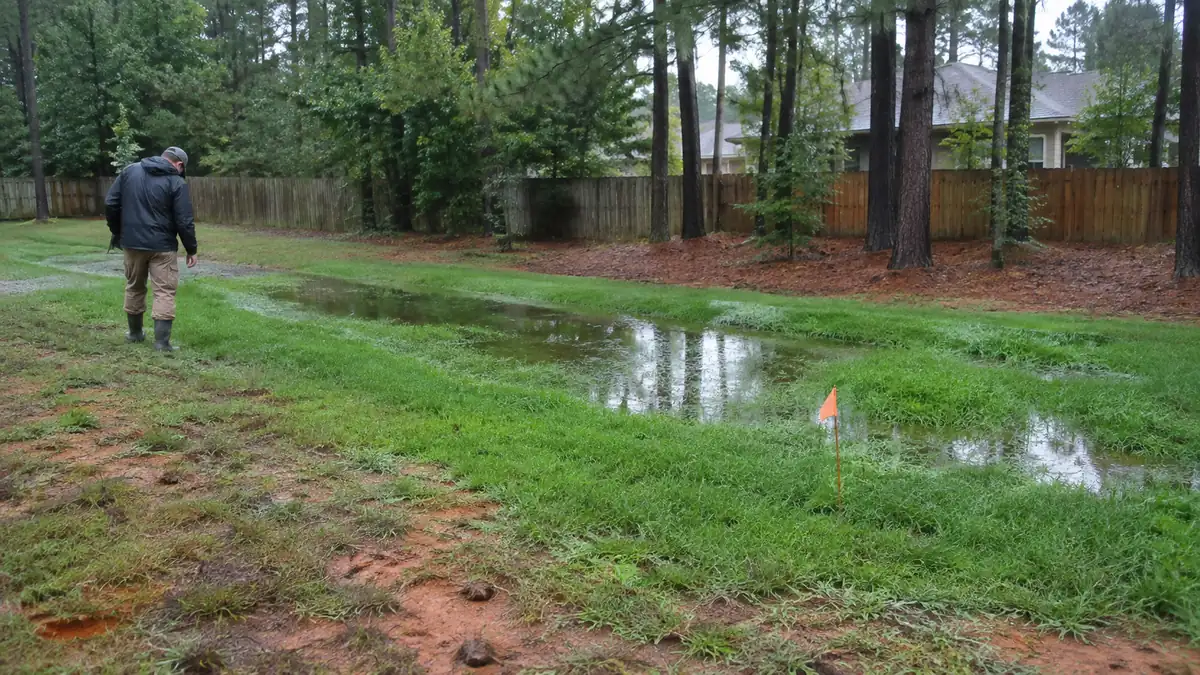
Alcovy Septic approaches drain field repair in Lawrenceville, GA the same way every time: diagnose before anyone quotes a replacement. A wet patch over the trenches is the one septic symptom most likely to get a homeowner sold a five-figure job, and a meaningful share of the fields we are called to look at turn out to have a silted distribution box, one rooted lateral, or soil that was simply saturated after a wet week.
Diagnose before you replace
There is an order to this, and skipping steps is expensive.
Rule out the tank first. A dropped outlet baffle or a packed effluent filter produces exactly the symptoms of a failed field: slow drains, backups that return days after a pump-out, effluent where it should not be. Worse, a tank with no outlet baffle has been sending grease and solids into the trenches for years, which is what killed the field. Replacing the field without fixing that guarantees you buy a second one. See septic tank repair for what usually turns up.
Open the distribution box. The D-box takes the outlet line and splits it across the laterals. When it settles out of level, cracks or silts up, one trench takes the entire household flow and drowns while the others sit dry. That is the classic “green stripe over one line” pattern: it looks like total failure from the surface while being one of the cheapest fixes in the trade.
Then test the laterals. Each trench gets probed for ponding depth and checked for whether it still accepts water. A lateral clogged with roots or light biomat is a candidate for jetting. One where the soil interface has sealed along its full length is not.
Why fields fail here: Piedmont red clay
Lawrenceville sits on Cecil and Pacolet soils, the red kaolinitic clay subsoil over saprolite that defines the Georgia Piedmont. USDA’s official series descriptions put saturated hydraulic conductivity in that clay subsoil at roughly 0.6 to 2.0 cm per hour. That is workable for a drain field, but it is slow, and it leaves very little margin.
Now add the rainfall. This part of Georgia takes roughly 45 to 55 inches a year, much of it in summer thunderstorms and multi-day winter systems. When the subsoil is already at field capacity, the trenches have nowhere to push effluent. UGA Extension is direct about it: saturated soils cannot absorb effluent until they drain.
That is why so many local fields behave seasonally. They surface after a wet week, recover after a dry one, and the homeowner concludes it fixed itself. It did not. A field that surfaces after rain has no reserve left, and the next failure is the one that does not recover. Septic problems after heavy rain covers what to do in the moment, including why pumping a tank into fully saturated ground is not always the right call.
The clay also explains Georgia’s wide replacement pricing spread. Septic & Well Pro reports Piedmont clay around Atlanta as the most expensive region in the state for field work, precisely because clay frequently forces an engineered alternative rather than a conventional trench system.
Roots, compaction and the other killers
Roots. Pines, water oaks, willow oaks and sweetgums send roots toward the moisture in a drain field, and Georgia’s long growing season means they work at it most of the year. Roots rarely destroy a field outright; they clog laterals and the D-box, starving the rest of the system. Tree roots in a septic system covers safe planting distances.
Compaction. Driving or parking over a field crushes the trench structure and compacts the soil that is supposed to absorb effluent. So does a shed, a pool or a new driveway. The damage is permanent and entirely avoidable.
Hydraulic overload. A leaking toilet flapper, a water softener discharging into the tank, or stormwater entering through a failed lid can double the daily volume reaching the field without anyone noticing. Fixing the source often buys a struggling field years.
Solids from the tank. Back to the outlet baffle and the filter. This is the single most preventable cause of premature field failure, and it is why every one of our visits includes pulling and cleaning the outlet filter.
Cheaper options before replacement
Jetting the laterals. High-pressure water run through the lines clears roots, sludge and light biomat, restoring flow to starved trenches. It will not resurrect sealed soil, but on a clogged line it is a fraction of the cost of digging. See septic line jetting and pumping vs cleaning vs jetting.
Distribution box repair. Resetting a settled box, replacing a cracked one or fitting flow levelers to balance the laterals is minor work with a major effect. Georgia providers put minor fixes of this kind, including D-box replacement and pipe repair, at $500 to $2,000, and most D-box jobs land between $500 and $1,500.
Partial repair. Where one or two trenches have failed and the rest of the field still accepts flow, replacing just those laterals runs $2,000 to $5,000.
Resting the field. Not a repair, but real. Cutting water use hard for several weeks, fixing leaks and diverting downspouts away from the field can let a marginal field recover enough to keep working while you plan.
What a drain field costs in Georgia
| Work | Range | Source |
|---|---|---|
| Minor fixes (D-box, pipe repair) | $500–$2,000 | Septic & Well Pro, 2026 |
| Partial repair, one or two trenches | $2,000–$5,000 | Septic & Well Pro, 2026 |
| Full replacement, statewide | $6,000–$15,000+ | Septic & Well Pro, 2026 |
| Full replacement, Piedmont clay | $8,000–$20,000+ | Septic & Well Pro, 2026 |
| Full system replacement, metro Atlanta and north Georgia | $10,000–$25,000 | SepticRooter |
SepticRooter puts most residential full system replacements in metro Atlanta and north Georgia at $10,000 to $25,000, the band clay lots needing an engineered or alternative system tend to land in. The breakdown by system type is in our Georgia drain field replacement cost guide. Every number above is a published market range, not our quote, and the quote is confirmed before work starts.
Permits and the Level 3 soil report
Drain field repair that modifies the system requires a permit from GNR Environmental Health, the district covering Gwinnett, Newton and Rockdale, and the office that issues them is on Grayson Highway in Lawrenceville.
The condition to plan for: GNR has required a Level 3 soil report for all septic permits since February 7, 2022 — new installs, repairs and additions requiring modification to the existing system. A Level 3 report means a qualified soil classifier comes out, digs, describes the horizons and certifies what the soil will actually accept. On Piedmont clay that report is also what determines whether a conventional trench replacement is even permittable or whether you are looking at an engineered system.
Start where the money is smallest. Book a septic tank inspection so the tank is ruled in or out, run the septic system assessment for a read on urgency, and use contact to schedule with a price range before anyone digs.
What's included
- Tank pumped and inspected first to rule it out
- Outlet baffle and effluent filter checked as a cause
- Distribution box located, opened and inspected
- Flow to each lateral observed and compared
- Field walked and probed for ponding and surfacing
- Laterals jetted where a line is clogged rather than failed
- Written findings separating repair from replacement
- Permit and Level 3 soil report requirements explained
Sources
- USDA NRCS — Cecil soil series official description
- USDA NRCS — Pacolet soil series official description
- UGA Extension — Recent rainfalls create septic problems for some homeowners
- Septic & Well Pro — Drain field repair cost Georgia (2026)
- SepticRooter — Septic replacement cost in Georgia
- GNR Public Health — Septic systems and permit requirements
- EPA — Resolving septic system malfunctions