Last updated:
Alcovy Septic does septic tank repair in Lawrenceville, GA on the components that actually fail: dropped baffles, broken lids, clogged outlet filters, separated inlet joints and root intrusion. Almost every one of those will back a house up exactly the way a full tank does, and almost every one of them costs a small fraction of what a replacement tank or a new drain field costs. The work starts with pumping and looking, not with a quote.
Cracked and dropped baffles
This is the most common repairable defect we write up, and Gwinnett’s housing stock explains why. Atlanta Regional Commission housing-age data puts about 23 percent of the county’s homes in the 1980s and about 30 percent in the 1990s, which means an enormous number of local tanks are thirty to forty-five year old concrete with cast-in baffles.
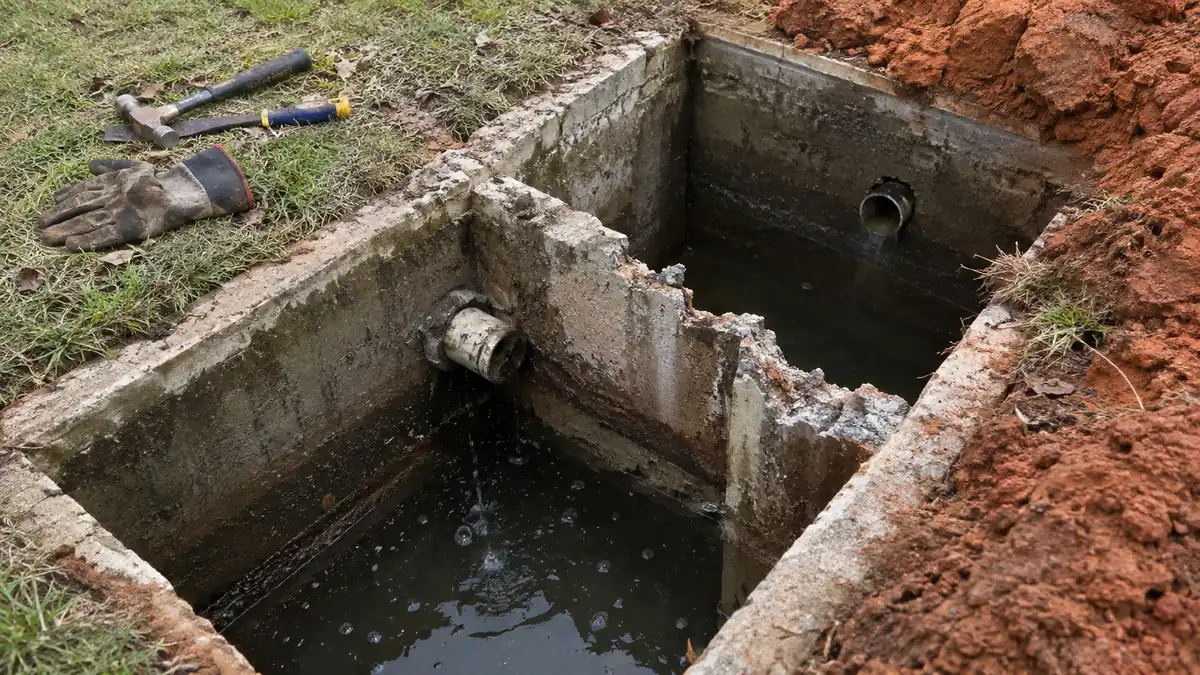
Those baffles corrode from the inside out. Sewer gas collects in the air space above the liquid, turns to acid on damp concrete, and eats away at the baffle where it meets the tank wall. Eventually the baffle cracks off and drops into the tank.
A dropped outlet baffle is the expensive one. Its job is to hold the floating scum mat back so only clear middle-layer effluent leaves the tank. With it gone, grease and solids flow straight down the outlet line and into the drain field trenches, where they clog the soil interface permanently. A field that fails fifteen years early very often turns out to have been fed by a tank with no outlet baffle for the last five of them. That is how a repair you could have done for a few hundred dollars becomes a drain field repair running into thousands.
A dropped inlet baffle is less dramatic but still bad. Incoming flow drops in without being directed downward, stirs the sludge blanket and pushes solids across the tank toward the outlet.
The fix is to rebuild the baffle or fit a sanitary tee on the inlet or outlet, done with the tank pumped and dry so the work can be seen. Georgia’s Rule 511-3-1-.05 also requires an approved filter on the outlet end, and a tee with a filter housing is often the cleanest way to restore both functions at once.
Lids, access openings and surface water
Concrete lids thin with age. Steel lids on tanks from the 1960s and 1970s rust through. Either failure is a genuine safety hazard on a family property, and either one lets stormwater into the tank.
The state rule is blunt about the second problem: all openings, risers and manholes must be constructed so as to prevent the entrance of surface water. A tank taking runoff every time it rains is a tank sending a surge of hydraulically loaded effluent to the field, on soil that is already saturated. That is one of the quieter reasons fields fail early around here.
Lid replacement is straightforward. The one thing worth deciding at the same time is whether to bring the opening to grade while it is open, because septic tank locating and risers is cheapest to do on a visit where the lid is already exposed.
Clogged outlet filters and failed pipe joints
Georgia requires an approved effluent filter on the tank outlet. It works, which is why it clogs. A packed filter restricts flow out of the tank, the level rises above the outlet invert, and the house backs up while the tank is nowhere near full of sludge. Homeowners read that as “the tank is full” and buy a pump-out that fixes the symptom for a few weeks.
Cleaning is maintenance and takes minutes with the lid at grade. See effluent filter cleaning for the routine. It becomes a repair when the cartridge or housing is broken, or when the filter clogged because the outlet baffle above it dropped debris onto it. The two failures travel together often enough that finding one means checking the other.
Inlet and outlet pipe joints are the other quiet failure. Where the house line enters the tank, PVC, clay or cast iron meets concrete, and decades of ground movement pull those joints apart. A separated inlet joint spills sewage into the soil beside the tank instead of into it, which shows up as a wet, smelly patch beside the tank with a normal level inside.
Root intrusion
Roots do not grow through concrete. They find the joints, the pipe penetrations, a failed lid seal or an old clay line, then thicken inside the opening until flow stops.
Lawrenceville yards are full of the species that do this best: loblolly pine, water oak, willow oak and sweetgum. Georgia’s warm climate keeps them growing most of the year. Cutting roots out of a line is a start, but if the joint that let them in is not repaired they come back within a couple of seasons. Tree roots in a septic system covers what to plant and how far away, and septic line jetting is what clears a rooted line before the joint is repaired.
Permits, soil reports and the county
Routine work does not need a permit. Pumping the tank, cleaning the filter and replacing a lid are maintenance. Anything that modifies the system does need one, and in this district that comes with a condition a lot of homeowners are not expecting.
GNR Public Health, which covers Gwinnett, Newton and Rockdale, has required a Level 3 soil report for all septic permits since February 7, 2022 — new installs, repairs, and additions requiring modification to the existing system, all of it, prior to permitting. The Gwinnett Environmental Health office that issues those permits is on Grayson Highway in Lawrenceville.
Know that before you plan the work: it adds a soil classifier’s site visit and report to both the schedule and the budget. It is also the strongest argument for an accurate diagnosis first, since a repair made without modifying the system avoids the permit path entirely. Our Gwinnett septic repair permit guide walks through the sequence.
When the tank is past repairing
Some tanks are not worth money. Cracks below the liquid line, a cracked floor, concrete spalling that exposes rebar, a tank that visibly drops level between visits, or a steel tank that has rusted through are all replacement territory. So is a tank that is simply too small for the house after an addition, since Georgia sizes tanks by bedroom count with a 1,000-gallon minimum for one to four bedrooms and 250 gallons more per bedroom above four.
Replacement needs a permit and a Level 3 soil report, and the honest version of that conversation includes the field. Septic & Well Pro puts drain field replacement in Georgia at $6,000 to $15,000 and higher, with Piedmont clay lots running $8,000 to $20,000 and up. Those are the numbers a cheap baffle repair is protecting you from.
Start with a septic tank inspection so the decision is based on what is actually in the tank. If drains are slowing now, signs a septic tank needs pumping will tell you whether this is urgent, and contact gets you a price range before anything is dispatched.
What's included
- Tank pumped so components can be seen dry
- Inlet and outlet baffles inspected and measured
- Effluent filter pulled, cleaned or replaced
- Lid and access collar condition assessed
- Inlet and outlet pipe joints checked for separation
- Tank walls checked for cracking and root entry
- Written findings with photos where useful
- Permit and soil report requirements explained before work